



Howdy
Hero background

Our blog

Beyond the Script: When Python Becomes a Product

Howdy joined the Pythonistas GDL meetup as a sponsor, where two talks showcased how to build intelligent agents with LangGraph and Google Cloud, and how to turn scripts into real products using NiceGUI to create web interfaces entirely in Python.

Publicado:
LinkedInTwitter
Phytonistas GDL Meetup
Logotipo de Howdy.com
Redacción Howdy.com

Content

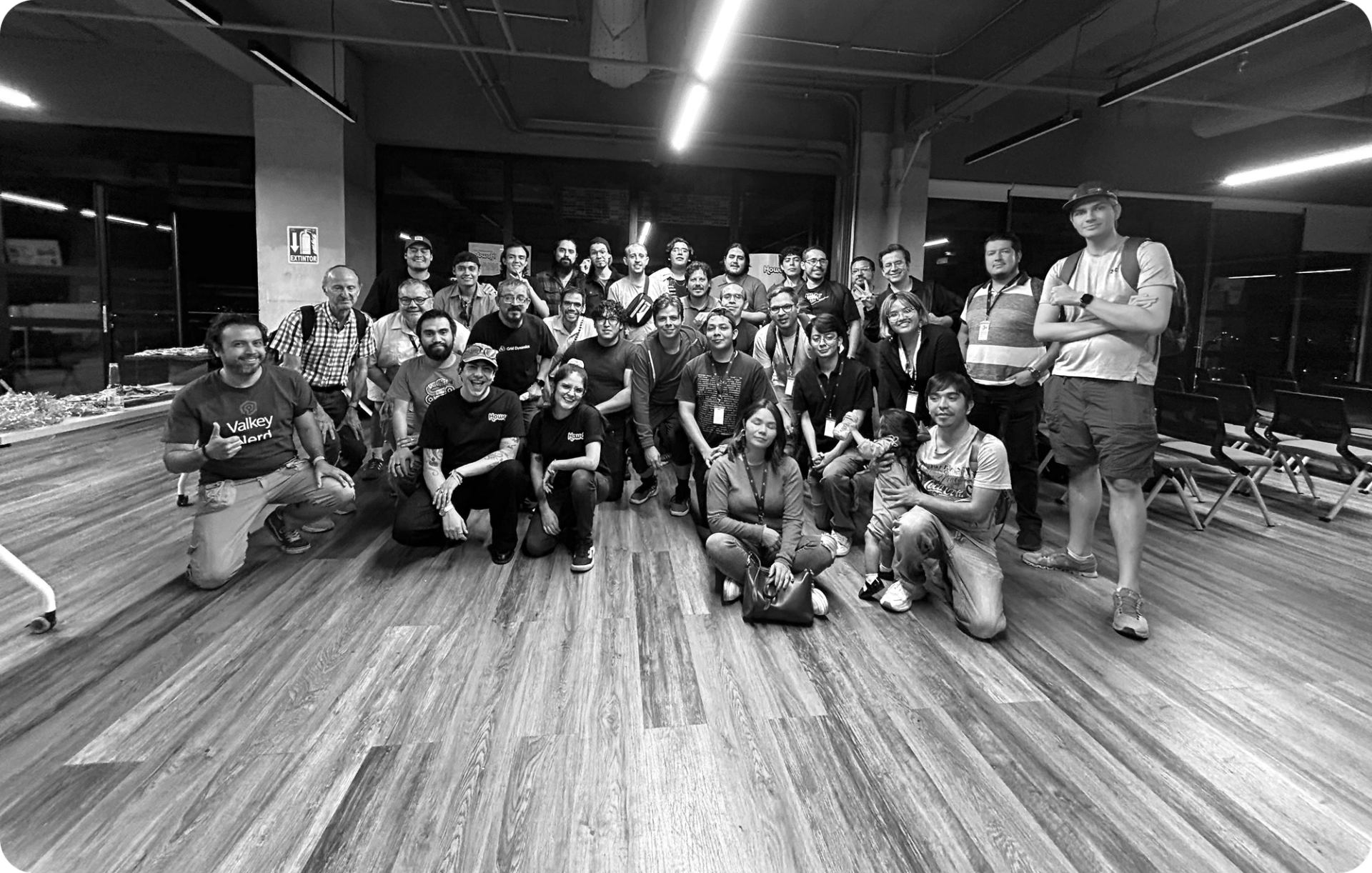
    Last Friday, April 24th, in Guadalajara, the Pythonistas GDL community organized a meetup to prove that Python is no longer just an automation or data analysis tool.

    Howdy was there as a sponsor, supporting the community and the two talks of the evening: one on autonomous agents with Python and Google Cloud, and another on NiceGUI for building web interfaces in pure Python.

  1. A chatbot is not artificial intelligence
  2. José Muñoz opened his talk with a clear premise: a chatbot is barely the most basic form of artificial intelligence. Traditional bots rely on linear flows, massive prompts, and perfect conditions. The moment something breaks — a timeout, a poorly generated query, a user typo — the system has no way to recover.

    The alternative he proposed is to think in terms of agents: systems with shared state, the ability to reason about their own steps, access to specialized tools, and, above all, self-correction mechanisms. To illustrate this, he compared a pure LangChain implementation against an agent built with LangGraph on Google Cloud, using public MiBici GDL (Guadalajara Public Bike System) data loaded into BigQuery.

    The results spoke for themselves. When faced with typo-ridden questions, semantic references like "Chapu" (instead of Chapultepec), or complex queries combining geolocation, gender, and year, the agent didn't just perform better — it was also faster, because it could introspect the schema, fix queries on the fly, and retry without any human intervention.

    Never blindly trust an LLM

    Between the lines, José left a warning that applies to any team integrating AI into their products: the real leap isn't using a bigger model — it's designing the architecture around it. Well-defined tools, shared state, external validations, and error recovery are what separate a pretty prototype from a system that actually works in production.

  3. From code to users: the missing link
  4. Juan Carlos Sedano opened his talk with a familiar problem: there's a lot of useful Python code out there — scripts, models, agents — that never actually reaches real users. The traditional options for bridging that gap, whether Tkinter, PyQt, or Flask with HTML/CSS/JS, come with steep learning curves and timelines that aren't always available. Streamlit and Gradio are handy for machine learning demos, but they have a narrow focus. That's where NiceGUI comes in: a framework that lets you build web interfaces — and even desktop apps — using primarily Python.

    With just a few imports, Juan Carlos demoed labels, buttons, sliders, checkboxes, layouts with containers, Tailwind-based styling, async callbacks over WebSockets, data binding, and FastAPI-style decorated routes. All from Python, with hot reload, and without touching a single line of JavaScript. Under the hood it runs FastAPI, Vue 3, and Quasar — but that complexity stays abstracted away for anyone who just needs things to work.

    NiceGUI doesn't replace React, and it doesn't have to

    The point isn't to compete with enterprise-scale frontend frameworks. NiceGUI shines where the priority is showing value fast: internal tools, dashboards, monitoring, IoT, robotics, or any scenario where turning a script into a usable interface matters more than months of frontend development.

  5. The combo that changes everything
  6. The most interesting part of the evening was watching how both talks complemented each other without having explicitly planned it. José showed how to build systems that perceive context, choose tools, and self-correct. Juan Carlos showed how to give them a friendly face without ever leaving Python. Together, the two talks articulated a powerful idea: without switching programming languages, you can do agentic backend development and build a polished frontend to enjoy using it.

    At Howdy, we support these conversations because we believe the best ideas — and the best tech talent — are born in community.

    If you missed the meetup, you can watch the full stream here:

    [@portabletext/react] Unknown block type "blogPostYouTube", specify a component for it in the `components.types` prop

Last Friday, April 24th, in Guadalajara, the Pythonistas GDL community organized a meetup to prove that Python is no longer just an automation or data analysis tool.

Howdy was there as a sponsor, supporting the community and the two talks of the evening: one on autonomous agents with Python and Google Cloud, and another on NiceGUI for building web interfaces in pure Python.

A chatbot is not artificial intelligence

José Muñoz opened his talk with a clear premise: a chatbot is barely the most basic form of artificial intelligence. Traditional bots rely on linear flows, massive prompts, and perfect conditions. The moment something breaks — a timeout, a poorly generated query, a user typo — the system has no way to recover.

The alternative he proposed is to think in terms of agents: systems with shared state, the ability to reason about their own steps, access to specialized tools, and, above all, self-correction mechanisms. To illustrate this, he compared a pure LangChain implementation against an agent built with LangGraph on Google Cloud, using public MiBici GDL (Guadalajara Public Bike System) data loaded into BigQuery.

The results spoke for themselves. When faced with typo-ridden questions, semantic references like "Chapu" (instead of Chapultepec), or complex queries combining geolocation, gender, and year, the agent didn't just perform better — it was also faster, because it could introspect the schema, fix queries on the fly, and retry without any human intervention.

Never blindly trust an LLM

Between the lines, José left a warning that applies to any team integrating AI into their products: the real leap isn't using a bigger model — it's designing the architecture around it. Well-defined tools, shared state, external validations, and error recovery are what separate a pretty prototype from a system that actually works in production.

Juan Carlos Sedano opened his talk with a familiar problem: there's a lot of useful Python code out there — scripts, models, agents — that never actually reaches real users. The traditional options for bridging that gap, whether Tkinter, PyQt, or Flask with HTML/CSS/JS, come with steep learning curves and timelines that aren't always available. Streamlit and Gradio are handy for machine learning demos, but they have a narrow focus. That's where NiceGUI comes in: a framework that lets you build web interfaces — and even desktop apps — using primarily Python.

With just a few imports, Juan Carlos demoed labels, buttons, sliders, checkboxes, layouts with containers, Tailwind-based styling, async callbacks over WebSockets, data binding, and FastAPI-style decorated routes. All from Python, with hot reload, and without touching a single line of JavaScript. Under the hood it runs FastAPI, Vue 3, and Quasar — but that complexity stays abstracted away for anyone who just needs things to work.

NiceGUI doesn't replace React, and it doesn't have to

The point isn't to compete with enterprise-scale frontend frameworks. NiceGUI shines where the priority is showing value fast: internal tools, dashboards, monitoring, IoT, robotics, or any scenario where turning a script into a usable interface matters more than months of frontend development.

The combo that changes everything

The most interesting part of the evening was watching how both talks complemented each other without having explicitly planned it. José showed how to build systems that perceive context, choose tools, and self-correct. Juan Carlos showed how to give them a friendly face without ever leaving Python. Together, the two talks articulated a powerful idea: without switching programming languages, you can do agentic backend development and build a polished frontend to enjoy using it.

At Howdy, we support these conversations because we believe the best ideas — and the best tech talent — are born in community.

If you missed the meetup, you can watch the full stream here:

2xe5fiR1BU4 - - thumbnail