
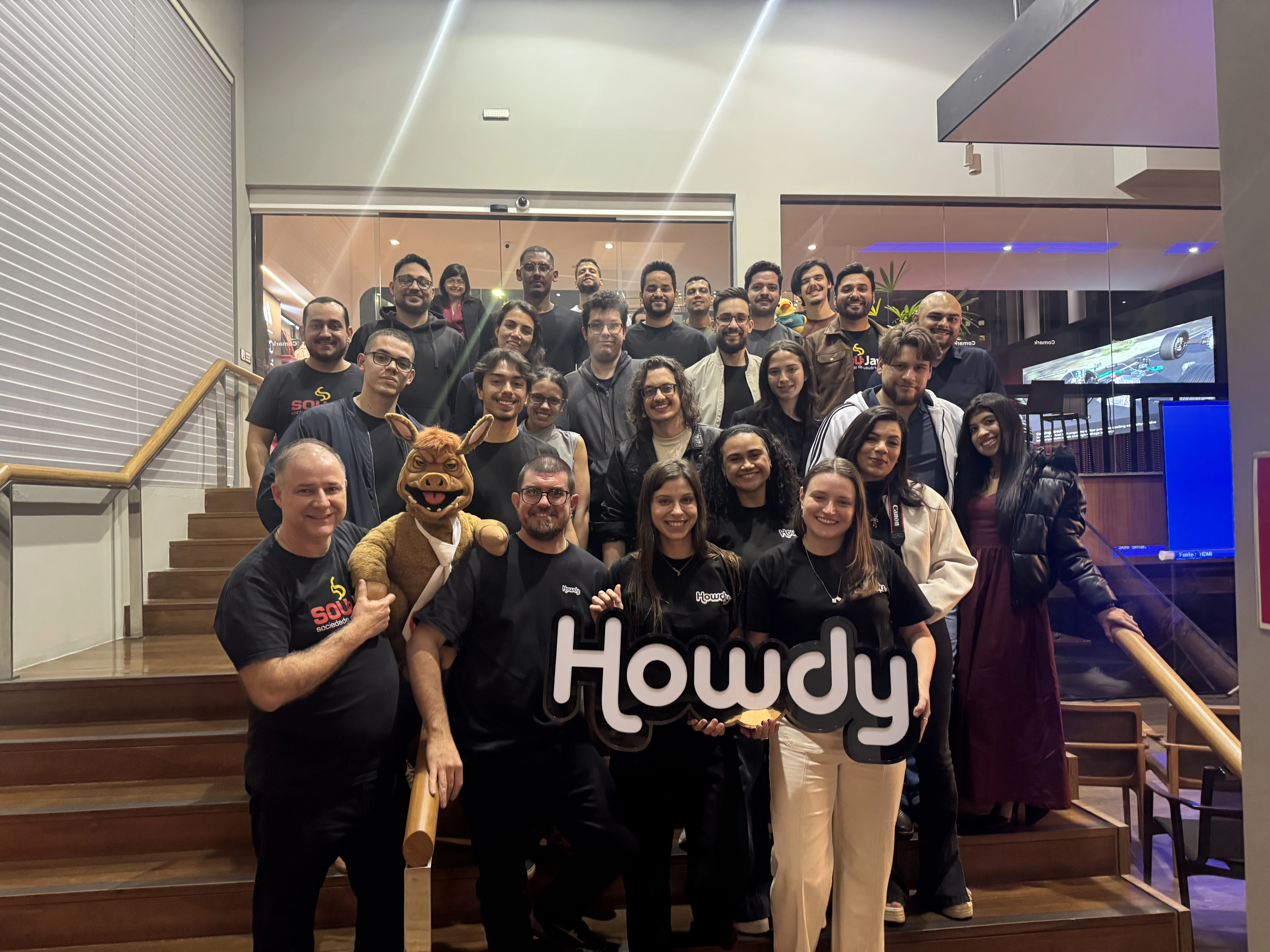
On July 31st we sponsored the Sou Java Meetup in São Paulo, at Limma Café, inside the Audi showroom on Faria Lima Avenue. It was an international edition, the kind Sou Java runs every two or three months entirely in English, so Brazil's Java community can practice the language in a real setting and think about a career beyond Brazil. In-person spots were capped at fifty, and anyone who could not make it followed along on the livestream from other cities. Things kicked off at seven, with bruschetta and bread rolls making their way around the tables, and with Darío's introduction, who had flown in from Uruguay for the occasion: proof that English was being spoken for real that night. The room filled up, and both talks earned a long round of questions, the first one especially.
Context Before Meetings
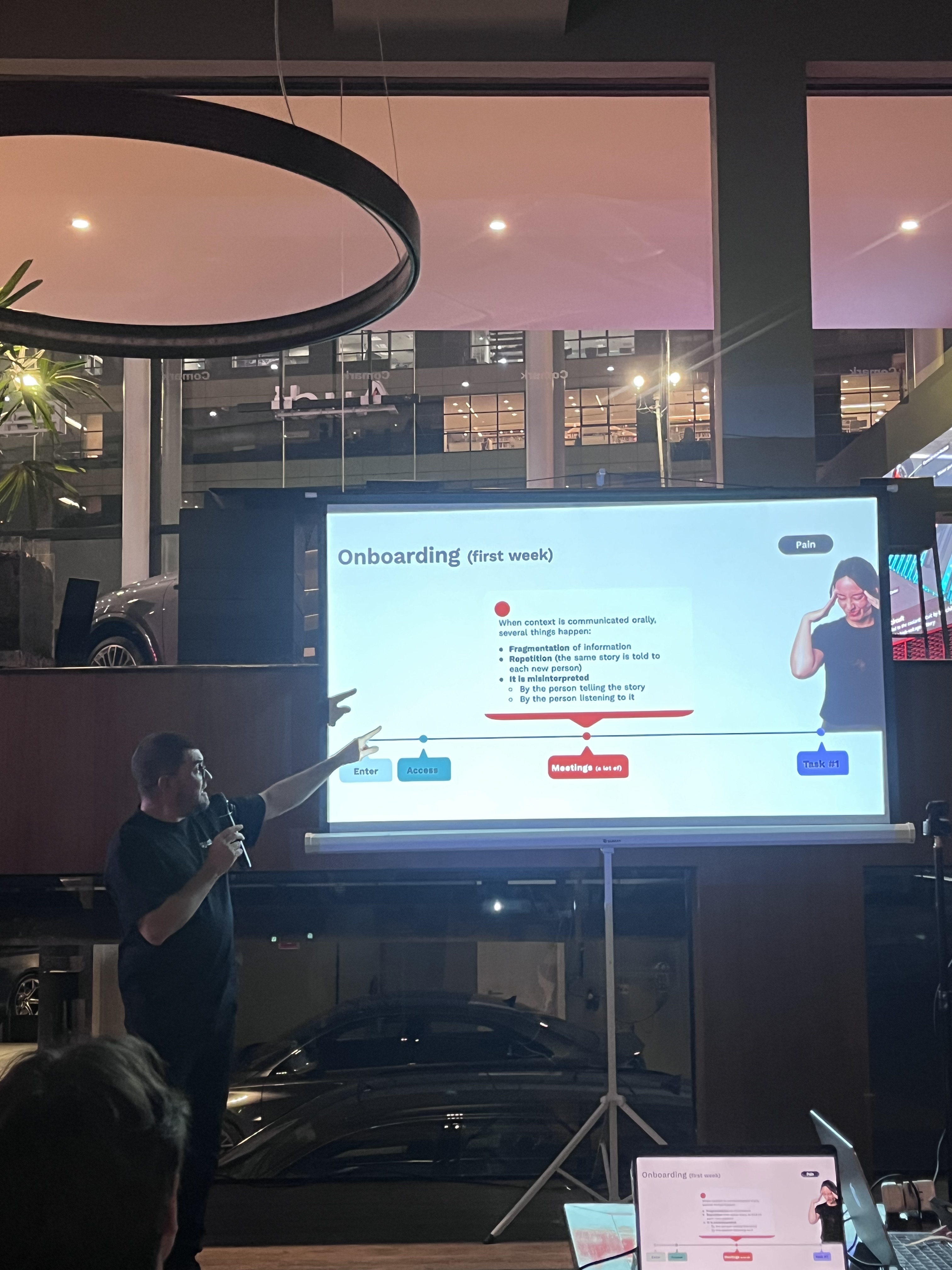
Darío Macchi, Dev Advocate at Howdy, opened the night with something anyone who has ever brought someone new onto a team knows by heart: traditional onboarding does not really work, because knowledge lives scattered across repositories, Slack messages, pull request comments, and conversations nobody wrote down. When someone new joins, all of that has to be rebuilt in a rush, through meetings that repeat with every new hire and never quite manage to explain what actually matters.
His proposal is simple to explain and not that hard to put into practice: before the new person starts, write a small document, a markdown file, with the specific context they need to solve their first task. Not the whole project, just what matters for that one task, like which files to touch, which ones not to touch, and how to validate that it works. Darío calls it day zero. And the idea did not start with people, it started with how we give context to an AI. He said he realized, only a few months ago, that he was not just onboarding a new person, he was also onboarding the AI that person would use.
After testing it with his own team and with a much larger one, the result was sharper questions, fewer interruptions for the rest of the team, and more focused code reviews, because everyone already knew which files were going to change. And one effect nobody expected: for the first time in years, his projects have real documentation, written because it was needed, not because someone asked for it.
The GPS Does Not Set the Route, It Sets the Destination
Bruno Souza, president of Sou Java and Java Champion, closed the night with a talk on careers that was less technical and much more about how we think through big decisions. His core idea: when you set a GPS, you do not pick every street, you pick the destination and let the route adjust itself along the way. Careers work the same way. The route is going to change a thousand times, but losing sight of the destination is what actually holds people back.
He told the story of the hare and the tortoise from a different angle: the hare does not lose because it is lazy, it loses because its goal feels so small and so easy that it keeps putting it off. The tortoise, on the other hand, has the most important race of its life ahead of it and never lets up. Bruno brought it down to something concrete: figure out your big goal, and stop spending your day on things that do not get you closer to it (social media, waiting around for an AI to finish answering, whatever it is), even when they feel comfortable.
He also pushed on something you notice at every meetup like this one: things change through small actions, not through huge decisions. A tip you gave someone at a previous talk, a question you finally worked up the nerve to ask, an event you went to without much enthusiasm. None of it looks like a big deal in the moment, and it ends up being what changes your career.
What the Community Took Home
From talking with the people who came, around seventy percent did not know Howdy before that night, and for us that is exactly what we look for in these gatherings: showing up in the conversation of a real technical community, without selling anything, contributing something worth listening to. The Sou Java team rated us at the top of the scale and described us as organized and clear to work with, so we are already looking forward to doing it again.
Later, people lingered at the café inside the same showroom, still talking about what they had just heard. In the days that followed, several LinkedIn posts thanking Sou Java and Howdy added up to hundreds of reactions between them, which is not common for a technical meetup on a Friday night. And one idea kept coming back in almost every one of them: that practicing English in a real technical setting changes the conversation, because for an international career the language stops being a nice extra and becomes something you use every day.
What came up most in the comments after the event was exactly what Sou Java aims for with these editions: the chance to practice English in a real technical setting while learning something you can use the very next day. We left with the same feeling, and we are already thinking about the next edition.


